Did you know that one of the most important armies in WWII history was a complete and total fraud? Or that one angry bull was able to destroy one of General Patton’s Sherman tanks?
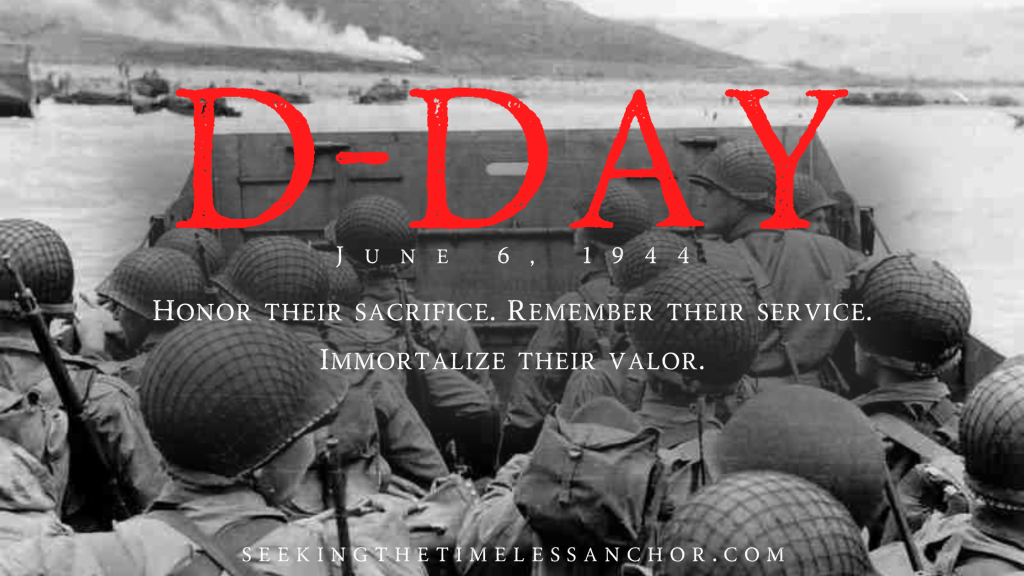
Yesterday we talked about planning D-Day and the intricacies of pulling off such a large scale invasion. One of the cleverest parts of maintaining the D-Day secret was General Patton’s First Army.
The large scale operation of deception enveloping D-Day was codenamed “Bodyguard”. The reason for the codename was found in something Winston Churchill said.
“In war time, truth is so precious that she should always be attended by a bodyguard of lies.”
Winston Churchill
Bodyguard was divided into smaller operations, all centered on keeping D-Day a complete secret. One of these operations was Operation Fortitude South. Its mission was to ensure the Nazis believed that the Allied invasion would take place at Calais.
One way in which the Allies planned to do this was through creating an army in southern England. If the Germans believed that there was a large army group gathering there, it would give credibility to an invasion at Calais.
This would not be an ordinary army. No, it would consist of inflatable tanks, imaginary divisions, and landing craft made of bailing wire and empty oil cans.
In order to convince the Germans that this army was one to be taken seriously, it had to be commanded by a renowned General. George Patton fit the bill. He was one of the Allies’ most feared generals. If he led the ghost army it would mislead the Germans into believing it was real.
On paper, Patton’s First Army was inconceivably large. So much so that the Germans believed the Allied invasion force was 70% larger than the force that actually landed on D-Day.
How did they pull it off?
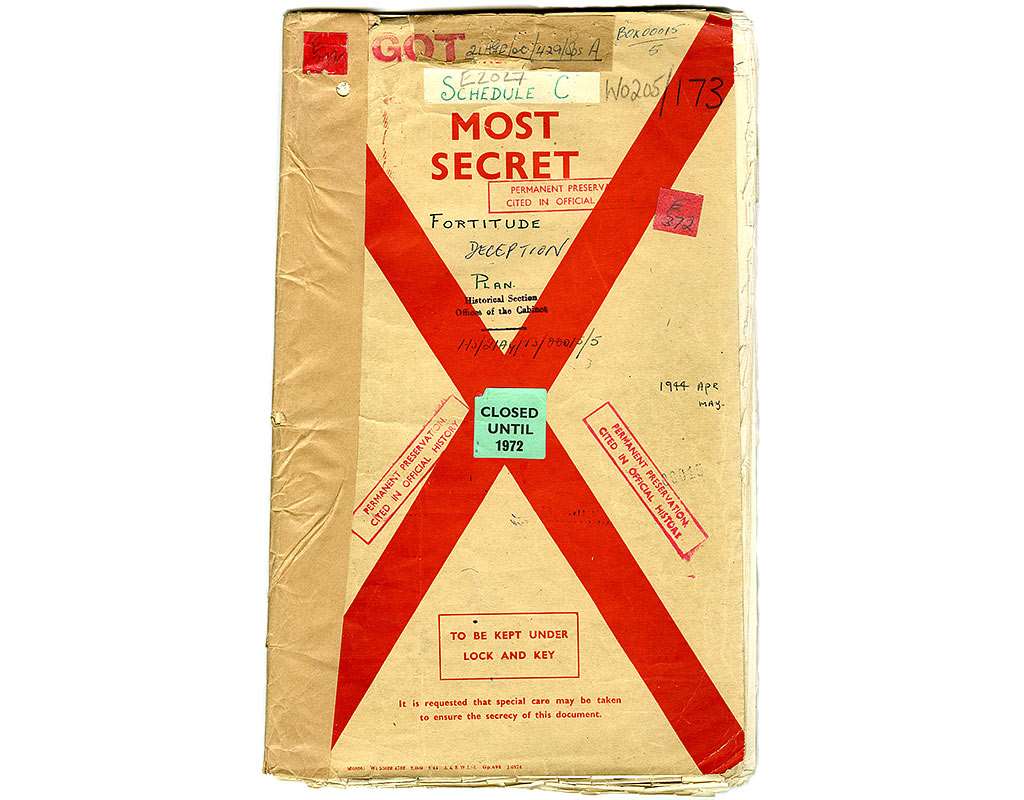
It was more than simply putting up cities of tents and strategically placing inflatable tanks. The Germans routinely flew reconnaissance missions to gather information on Allied military buildup in England.
Patton’s ghost army was one military operation the Allies wanted Germany to get a good gander of. To ensure this, the Allied antiaircraft defenses guarding the coasts had to let German planes through but put up enough of a fight so that suspicion would not be aroused.
Not only did they have to worry about making sure the reconnaissance teams got through, but they also had to make the ghost army look and act like a real army. It would be suspicious to the Germans flying reconnaissance if everything was in exactly the same placement every time they made their runs.
To avoid this, the Allies moved their fake tanks and jeeps to different locations under cover of darkness. Men involved with Operation Fortitude went along behind the tanks and used special tools to create tread marks on the ground.
One British farmer looked out on his field one morning only to discover that it was filled with military tanks that had not been there the previous day. His bull also noticed, as it eyed the tanks suspiciously and then charged straight at one. The farmer expected to watch his bull break its neck as it collided with the steel armor on the tank, but was shocked when the bull’s horn pierced the side of the tank. Slowly the rubber tank deflated into a crumpled heap.
The farmer had accidentally stumbled across the greatest military deception in the history of warfare.
The Allies didn’t rely solely on German reconnaissance teams to take the bait of Operation Fortitude South. Newspaper articles were planted, describing British civilians complaining about the bad behavior of imaginary American troops stationed in the area.
A select number of soldiers were given First Army patches to wear on their uniforms while they were on leave in nearby towns, ensuring that enemy agents and diplomats would pass on the information to their governments.
What happened to Patton’s ghost army after D-Day?
The mission of the ghost army didn’t end when the first troops landed at Normandy.
You see, the second half of their mission was to ensure that Germany still believed an invasion would take place at Calais, even while troops were landing at Normandy. This would prevent the Germans from moving reinforcements from Calais. It was perhaps the most important part of their mission.
D-Day dawned early on the morning of June 6. When word of the invasion began to reach the Nazi’s high command, they weren’t sure what to believe. Patton’s army was still focused at Calais, but Normandy was being hit with a vengeance.
Finally, a British double agent clenched the success of the First Army when he passed along a message reassuring the Germans that the Normandy invasion was a ruse to make them move troops from Calais. The troops were not moved, and D-Day succeeded.
Patton’s ghost army had accomplished its mission.
Had the First Army failed in deceiving the Germans, D-Day would have been one of the greatest Allied defeats of the war. Reinforcements from Calais would have been brought to Normandy and the Allies would have been forced back into the sea.
I can’t help but see that surely God’s hand was working in this regard as well.
A. M. Watson
Hebrews 13:8
 Seeking The Timeless Anchor
Yes, God’s hand was definitely in it.
Wow! That is amazing! Our Grandpa let us borrow a book of his that is about the ghost army! Its about some of the soldiers that were artists that were a part of designing, planning, and building the ghost army. The book is full of pictures and drawings of what they did. Its really neat!
LikeLike
Wow!!! I never knew that – that’s amazing! 😯
LikeLike