It has been quite a while since we have focused on any hymn stories. Last time we looked at “Jesus Loves Me” and its incredible impact on believers around the world. If you missed that post, you can check it out here.
A hymn that has always been one of my favorites is “What A Friend We Have In Jesus”. It’s absolutely gorgeous to play on piano and somehow my hymnal seems to fall open to it frequently. It was even the first solo I ever sang for a church service. I was seven at the time and had no way of knowing how much meaning and depth there really is in the words.
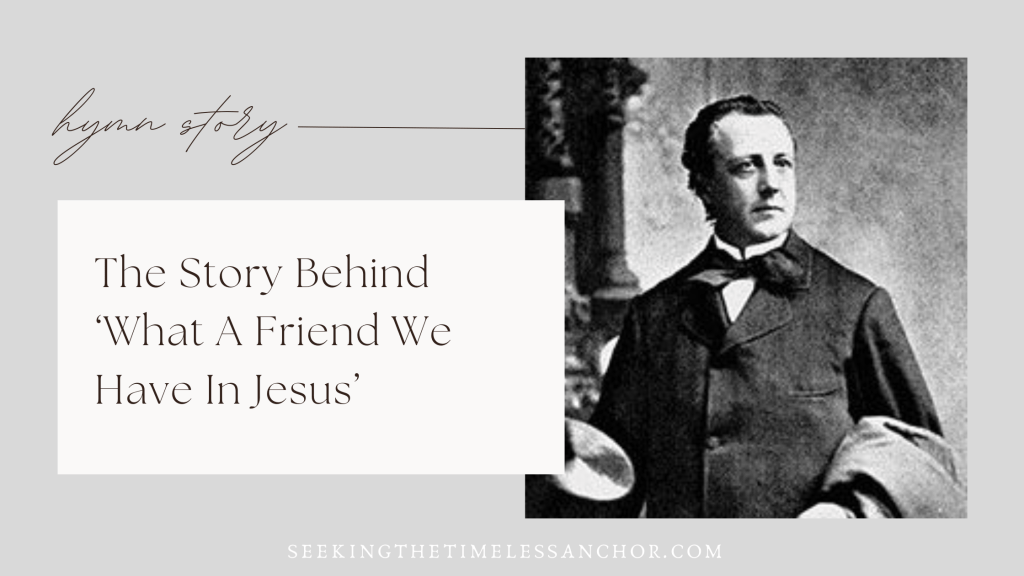
But not just to each of us as we face the hardships of living in this world. The author, Joseph Scriven, knew deeply the significance of the words he penned. When we understand what the author’s life was like, we can often better understand just how much meaning is in the words we sing.
What a Friend we have in Jesus,
all our sins and griefs to bear!
What a privilege to carry
everything to God in prayer!
O what peace we often forfeit,
O what needless pain we bear—
All because we do not carry
everything to God in prayer.
The Sorrows That Penned The Hymn
The hills of Ireland were lush with vibrant green grass in the spring of 1843. For Joseph Scriven it was a time of immense hope and joy. This was the year that his childhood sweetheart was to become his wife.
One can imagine the dreams and hopes that they held for their future together. But tragedy shattered the happiness when, on the day before their wedding, his fiancee was drowned in an accident on the River Bann. Scriven arrived at the river a short time after the accident occurred, but was too late to help her. He watched helplessly as others who had gathered carried her body away. He said, in regard to that day, “The bottom of my world seemed to disappear.”
Can we find a friend so faithful
who will all our sorrows share?
Jesus knows our every weakness;
take it to the Lord in prayer!
Remaining in Ireland after enduring such tragedy was too much for Scriven to bear. The gorgeous landscapes of his home only reminded him of the beautiful life they were supposed to have had together but were never given. He moved to Canada only two years after losing his fiancee. His health, however, was not strong enough to withstand the brutal climate, and he was forced to return to Europe.
He found work in Plymouth, England as a tutor to a wealthy family, and accompanied them on a journey to the Middle East the following year. It was during this time that it is believed he penned the rough draft of a poem which he entitled “Pray Without Ceasing”. The very first line read, “What a friend we have in Jesus”.
While Scriven was in the Middle East, he once again fell for a young lady whom he hoped to court. The relationship ended relatively quickly though when her heart was stolen by another man. In the wake of this disappointment, Scriven left the employ of the family he had been working for and made his way back to Ontario, Canada.
He procured another job as a tutor for a family by the name of Pengelly. It was during this time that he first met their niece, Eliza Roche. A slow friendship between the two blossomed into an engagement over the course of several years.
Eliza wanted to be baptized into the assembly that Scriven was part of. In April of 1860, she was baptized in the partially ice-covered water of Rice Lake. The icy water caused her to develop a severe case of pneumonia. She never recovered, though Scriven and her family cared for her arduously. On August 6th she passed away.
This experience left him devastated. Yet somehow it placed inside of him a deep devotion for taking care of others. That is what he threw his entire heart, soul, and mind into doing.
A Life Of Sacrifice
Many who knew Joseph Scriven said that he was a man of selfless compassion. He often could be found cutting firewood for elderly widows and attending to the needs of poverty-stricken families. He only worked for those who could not afford to pay him, never charging them a cent. A story is recounted that once, when a poor family lost their cow, Joseph Scriven sold the watch he had brought from Ireland in order to buy the family a new cow. And it is said that his family cut him off financially when they found out that he gave away his money and possessions to the poor.
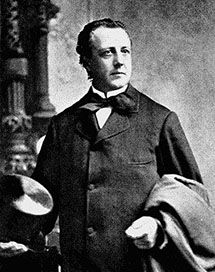
While living and working in Huron County, he routinely went to read the Bible aloud to the railroad workers who were constructing the Grand Trunk Railway. He would distribute gospel tracts and printed hymns to the workers. Many of them came to respect him for his kindness and care for every soul he met.
However not everyone appreciated his efforts to share Christ’s love with others. He often preached on the street corners of his town. This brought him under the scrutiny and persecution of many. He was beaten by locals who didn’t want him preaching. People threw mud and rotten fruit at him. He was even arrested and commanded to cease preaching.
It makes one understand the depths of the words he penned so much better. Were these experiences what led him to write the third verse?
Do thy friends despise, forsake thee?
Take it to the Lord in prayer!
In his arms he’ll take and shield thee;
Thou wilt find a solace there.
Many people would be turned bitter and angry by the tragedies he suffered at such a young age. While Scriven did battle depression, he did not let it consume him. He poured his grief and sorrow into a deep compassion for those around him. His life was characterized by service to others.
The Mystery That Was Never Solved
Jospeh Scriven was never blessed with a family of his own. But he did have one very dear friend who became like family to him, James Sackville. He had lived with the Sackville family for a time prior to his engagement to Eliza Roche.
Some believe that it was Sackville who first found the completed poem “What A Friend We Have In Jesus” and asked if Scriven had written the words.
Scriven replied, “The Lord and I did it between us.”
Sometime before, Scriven’s mother had fallen ill back in Dublin. He was unable to travel back to be with her due to his financial burdens. He did, however, send a copy of the poem to her in hope that it would be a comfort.
Scriven had battled health issues on and off throughout his life. It was no surprise when he fell ill with a raging fever. James Sackville brought Scriven to his home to care for him.
One night his fever grew worse and he slipped into delirium. It is reported that he repeatedly cried out for God to take him Home. At some point, Sackville left his friend’s bedside to go into another room and pray. When he returned a while later, Scriven was nowhere to be found.
Immediately a search party was formed and the entire property was turned upside. Scriven was found face down in the river, drowned.
It was never determined exactly what happened that night. Some speculate that he wandered out of the house in search of water but passed out on the river’s edge. A few have wondered if he took his own life that night, perhaps being overwhelmed with delirium and depression.
He is buried beside Eliza Roche.
The Impact Of A Life Lived For Others
Joseph Scriven once published a book of poems and hymns that he had written. It contained over 90 pieces of poetry and songs. But the one poem never contained within its pages was “What A Friend We Have In Jesus”.
The reason why is a bit of a mystery. It was most likely written at the time that he published the collection. But for some reason he didn’t include it.
A plausible answer to that question seems to lie in the fact that this poem was different than other poems he wrote. It was written as a series of questions, as if he was asking himself these things. The depth of the verses are far more personal than his other works. No doubt the many griefs that he knew in his lifetime influenced this poem, which would offer insight into why he did not include it in his collection to be shared with the entire world.
Most hymn scholars seem to agree that his mother was most likely the one who was responsible for the poem finding its way to the public after his death.
Scriven died without ever knowing the impact his life had on the world. His life was lived with incredible sorrows and afflictions. Even his death was brought about in a very tragic manner — all alone with no one but Jesus to see him Home.
But what he didn’t see and had no way of knowing was that his life would echo through the generations after him. His poem, born out of immense pain, would comfort thousands of christians around the world.
It is a song that has brought peace in the midst of heartache and loss. It has comforted soldiers amid the horrors of war. It has found its way into communist prisons. It has been an encouragement to countless lives, and is known world-wide.
Sometimes it is assumed that our greatest hymn writers were these perfect christians with a profound faith beyond our reach. But the truth is, almost all of them lived lives of deep trials and burdens. They struggled with trusting the hand of their Heavenly Father just like we do. They had times of doubt and crippling fear. They had failures and defeats.
The thing that made them giants in the christian faith is that they were faithful in spite of all that they faced. When we hear the words of the incredible songs they penned, we have to remember that faith this strong does not come from a life of ease. It is forged in the fires of tribulation.
Maybe, like Joseph Scriven, we will never know how our lives have impacted others. But remember — the only reason his life did impact generations of believers is because he kept walking with his Dearest Friend even when life was at its darkest.
A. M. Watson
Hebrews 13:8
Sources:
The Guide Newspaper
Sankey’s Story Of The Gospel Hymn
Memoir Of Joseph Scriven by Emily Pengelly
Hymns And Their Writers by Jack Strahan
 Seeking The Timeless Anchor