Imagine being brutally tortured and burned alive at the stake for following the Bible. That was the fate Michael Sattler resigned to because he chose to live for Jesus rather than cater to the world.
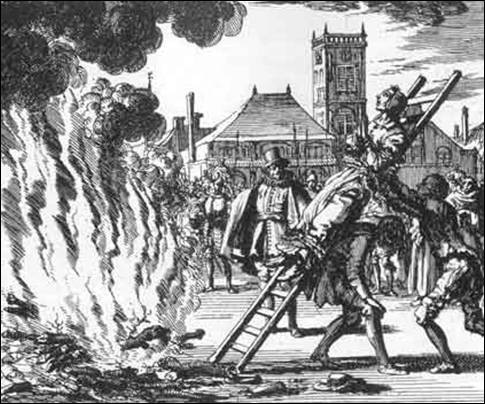
Michael Sattler was once a Catholic monk. He rose to the rank of Prior of the Benedictine Monastery near Freiburg, Germany. As he studied the scriptures, however, he began to see that the Catholic Church was in error and did not align with the Bible. He left the monastery and Catholic Church, and eventually married a woman who had once been a Catholic nun and had also become convinced of the scriptures.
This was a tumultuous time in history. The reformation was gaining strength and the Catholic Church was continuing its iron reign across much of Europe. Yet the Catholics and Protestant Reformers were unified in one point, and that was with regard to persecution of the Anabaptists.
The Anabaptists were considered heretics because of their belief that salvation is through grace by faith alone, that baptism is for believers by immersion only, as well as their belief that the Bible is the only authority for faith and practice.
Sattler quickly became a leader of the anabaptist movement in Switzerland and Germany, and consequently fell into the crosshairs of the local Catholic leaders.
On May 17, 1527, Sattler, his wife, and a group of fellow anabaptists were arrested and tried for so called religious “crimes”. The twenty-four judges that decided their fate were Catholic theologians. All of the nine crimes Sattler was charged with were deemed worthy of execution without trial, but because of Sattler’s popularity they feared an uprising of the people and decided it best to try him before passing sentence.
The charges brought against him were as follows:
- First, that he and his adherents have acted contrary to the mandate of the Emperor.
- Secondly, he has taught, held and believed that the body and blood of Christ are not present in the sacrament.
- Thirdly, he has taught and believed that infant baptism does not conduce to salvation.
- Fourthly, they have rejected the sacrament of extreme unction.
- Fifthly, they have despised and condemned the mother of God and the saints.
- Sixthly, he has declared that men are not to swear before the authorities.
- Seventhly, he has commenced a new and unheard of custom in regard to the Lord’s Supper, placing the bread and wine on a plate, and eating and drinking the same.
- Eighthly, he has left the order, and married a wife.
- Ninthly, he has said that if the Turks should invade the country, no resistance ought to be offered them; and if it were right to wage war, he would rather take the field against the Christians than against the Turks; and it is certainly a great matter, to set the greatest enemies of our holy faith against us.
Sattler gave a defense of each accusation with the scripture passage that addressed each one. He assured the council that if they showed him from the Bible that his beliefs were in error, he would willingly accept whatever punishment they deemed him worthy of. When presented this challenge, the catholic judges only became enraged. They found him guilty of heresy against the Catholic Church and sentenced him.
“In the case of the Governor of his Imperial Majesty versus Michael Sattler, judgment is passed, that Michael Sattler shall be delivered to the executioner, who shall lead him to the place of execution, and cut out his tongue; then throw him upon a wagon, and there tear his body twice with red hot tongs; and after he has been brought without the gate, he shall be pinched five times in the same manner.”
On May 21, 1527 Michael Sattler was martyred for Christ in the manner described. As he was bound and prepared to die, he cried out, “Almighty eternal God, thou art the way and the truth; because I have not been shown to be in error, I will with thy help on this day testify to the truth and seal it with my blood.”
Some records state that even after they had cut out part of his tongue, and while the flames burned his body, he could still be heard praying for his judges and executioners with what little voice he had left.
A few days later his wife was drowned for her faith, a death sentence that was popular among anabaptist persecutors. Protestant leader, Gastins, said “They like immersion. Let us immerse them.”
It must have seemed, to the persecutors who watched their deaths, that it would put an end to these pesky “heretics”. Who would take a chance at dying a death like these baptists had? Yet their courage in the face of persecution only emboldened many others to stand faithfully for the Word of God.
“And others had trial of cruel mockings and scourgings, yea, moreover of bonds and imprisonment: They were stoned, they were sawn asunder, were tempted, were slain with the sword: they wandered about in sheepskins and goatskins; being destitute, afflicted, tormented; (Of whom the world was not worthy.)”
Hebrews 11:36-38
Sources:
The People Called Baptists by Michael Johnson
The Trail of Blood by J. M. Carroll
Martyr’s Mirror by Thieleman Van Bragt
Way of Life Literature
The Faithful Baptist Witness by Dr. Phil Stringer
 Seeking The Timeless Anchor