Imagine having the money to purchase a pound of sugar from the store, but not being able to because you didn’t have enough rationing stamps.
That was everyday reality for Americans navigating the hardships of life on the Homefront of World War Two.
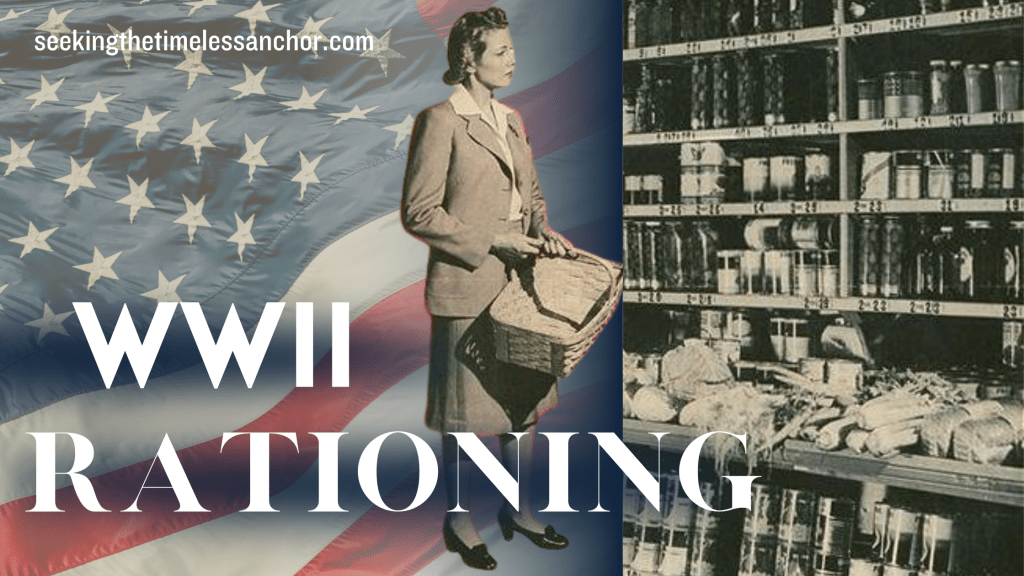
The Second World War saw the largest militarization of America in history up to that point. Thousands of soldiers and sailors were shipped overseas to fight the Axis powers. Practically overnight, America was turned upside down, our purpose being one thing—win the war.
Factories that had previously produced women’s stockings, started turning out silk parachutes instead. Companies who made upholstery nails before the war, began making cartridge clips for US military rifles. Well known vehicle companies, like Chrysler and Ford, switched over to producing B-24 Liberators.
It didn’t stop with factories and businesses though. The American people were called upon to change they way they lived their every day lives.
In 1942, the US Government implemented the rationing of tires. This was only the start of a program that would last into the aftermath of the war.
By March of 1943, the list of rationed items included: coffee, sugar, canned milk, meat, canned fish, cheese, bicycles, gasoline, and even certain types of medicine.
Rationing was implemented for several reasons, but two of them stand out to me.
1. Supply And Demand
One reason rationing came into effect was due to the rising problems with supply and demand for certain commodities.
America is blessed with the ability of being almost completely self-sufficient. Vast expanses of farm ground in the heartland of the country were able to provide food to sustain the nation. and at the time, America was producing 60% of all the crude oil in the world.
However, there still remained certain commodities that America was unable to produce herself.
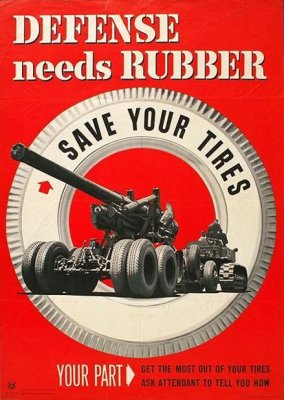
A prime example of this was the large-scale rubber shortage that was triggered by the war. Japan controlled the Dutch East Indies ( present-day Indonesia) from early 1942 through the end of the war in 1945. This cut back on 91% of American rubber supply.
Though efforts were being made by the US Government to replace natural rubber with synthetic rubber, it wasn’t enough to supply the military with all they needed.
To produce just one military airplane, 1,000 pounds of rubber was needed. To produce a battleship, it required 75 tons. During the war years, America was producing thousands of airplanes every day, and roughly one US Navy ship per day.
Rubber was needed for dozens of military vehicles, weapons, and equipment. One can imagine the drastic amount of rubber that was needed to sustain such production rates.
Due to the inability to access the supply of natural rubber in Indonesia, there just wasn’t enough rubber to meet the needs of
For these reasons, the US government implemented the rationing of rubber-made items. During the war it was impossible to buy brand new shoes, because they didn’t have the rubber available to make them. Tires were strictly rationed, only being used for purposes that would further the war effort.
2. Patriotism
Imagine an entire country rallying together for one cause — freedom.
Living in an era where there is a gross lack of patriotism, it is difficult to fully understand just what America looked like during World War Two.
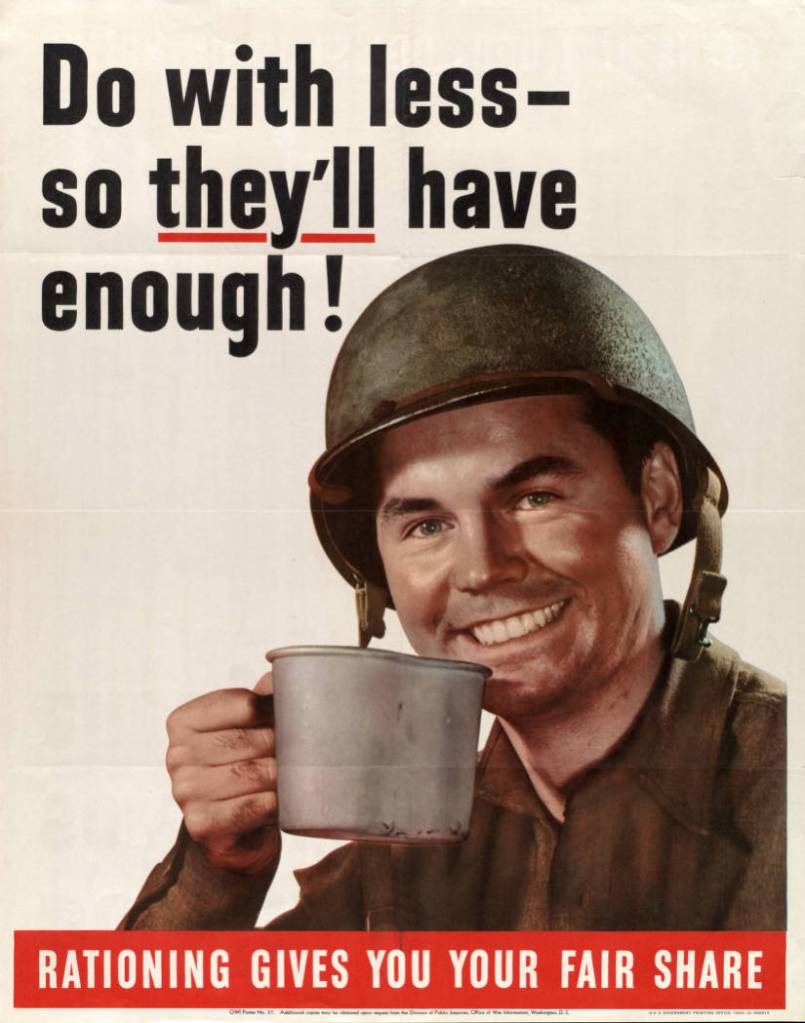
By and large, American turned into a fighting force that was to be reckoned with, united and strong. Citizens came together with the motto of “if our soldiers can sacrifice, so can we”. Many felt it was wrong to live lavishly and comfortably while our soldiers lived in atrocious conditions half-way around the world.
One way that they recognized how they were able to help the war effort was through rationing. Yes, rationing was enforced by the government during the war, but the majority of Americans would have done it anyway.
Most have probably heard the quote from Napoleon, “An army marches on its stomach”.
There is much truth to it. An army can’t survive on nothing.
America’s army was so large during WWII that it became imperative for the Homefront to sacrifice their food in order to feed their troops.
As was mentioned before, America was capable of producing her own food. However, she was now feeding hundreds of thousands of soldiers and sailors.
Not only did the increase in our military affect the supply chain, but also the fact that metals used to make cans for food were being put to use to further the war effort.
Instead of making cans for soup and vegetables to be sold in grocery stores, that metal was being turned into tanks and planes, rifles and jeeps. This meant that there were even less canned goods for Americans on the Homefront to buy.
All across the country, Americans came together to do their patriotic duty by making sacrifices throughout their every day lives.
I wonder how many of the current generation would be so willing to sacrifice for the cause of freedom? What do you think?
A. M. Watson
 Seeking The Timeless Anchor
That is very interesting! I knew that they rationed things during WWII, but I didn’t know that they rationed things that much.
LikeLiked by 1 person
Yes, it is so incredible to think of all the things they went without during the war. It gives me a lot of respect for them!
LikeLike
okay, I’m a little behind….at least a week.
We need to remember, also, that generation was part of WW1. Many of them fought in it. Their children were probably fighting in WW2. They also went through, or actually were still in the Great Depression. Through all of that, I believe, they understood “helping each other.” That is what makes them the greatest generation in the history of our country.
Fortunately, none of us have experienced that , to that degree, in our lifetimes. Which makes this country, we fortunately live in , the greatest in history. (Look around the world)
Today, it’s a crisis if the internet goes down for 15 minutes. Or we can’t check our social media every 15 minutes.
However, I’m reminded of 9/11 and remember how that event brought a divided country together. Even our elected officials stood on the stairs of the Nation’s Capital and sang “God Bless America “
That makes me believe that we ALL(well, a large majority of us) would step up and do the same thing!
Numbers 6:24-26
LikeLiked by 1 person
Yes, you’re absolutely right! They knew what it meant to “make do” in hard times. Their legacy to us is incredible.
LikeLike