Hello again, everyone! Some of you may have noticed the absence of a post yesterday. I fully intended to post, but some extensive medical circumstances took my time.
I’m back today though, and filled with anticipation for tomorrow’s commemoration!
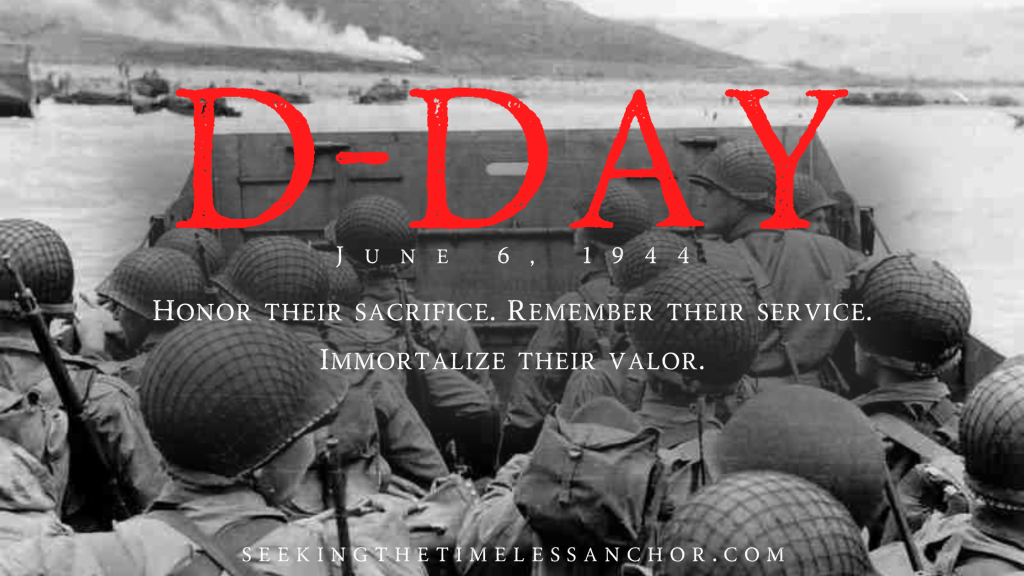
Freedom never comes without the horrible price of blood. Neither did the greatness of D-Day come without the loss of life.
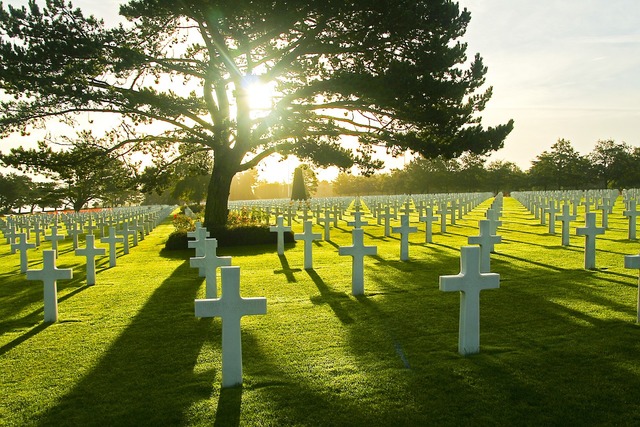
Most of you, I’m sure, have seen photographs of the incredibly heart rending rows of white crosses that dot the French countryside. Each cross represents a soldier who left the warm embrace of his family to free a continent gripped with the chilling embrace of war and death.
To this day, no one knows the exact number of casualties that the Allies suffered on D-Day. This is due to extreme circumstances that surrounded the battle and the inability to keep up with casualty reports. Entire units were displaced when they landed in the wrong zones, chaos consumed the beachheads, and the wounded were transported to ships offshore as quickly as possible which resulted in gaps in the casualty records.
However, it has been estimated that the Allies suffered 10,000 casualties on D-Day alone. Included in this number are those wounded, killed, and missing in action.
Casualties on the Beaches
1. Omaha Beach
Omaha Beach was won with the blood of American soldiers. It lies between Sainte-Honorine-des-Pertes and Vierville-sur- Mer — six miles wide. The highest number of casualties on D-Day came at this beachhead. It was the bloodiest of the five beaches due to the heavy concentration of German defenses.
Some units on Omaha Beach suffered over 90% casualty rates, most of them cut down before they ever made it out of the water. Others fared somewhat better, but none of them came out unscathed.
By the time night fell on the beachhead, 34,000 American soldiers had landed. Of that number, roughly 2,400 became casualties.
It was said that by the time the second wave hit, you could have walked along the beach on the bodies of fallen soldiers, never having to touch the ground.
2. Utah Beach
Utah was the second beachhead under American command. It was only three miles wide, from Pouppeville to La Madeleine, and was the farthest west of all the beaches.
On Utah Beach, defenses were not as heavy. But still the price of blood was paid for freedom. 23,000 soldiers landed on the three-mile-long beach, and only 197 men were wounded or killed.
3. Juno Beach
Juno Beach was mainly led by Canadian troops. It reached from La Rivière to Saint-Aubin-sur-Mer, a six mile stretch.
This was the beachhead that suffered the highest casualties of the British and Canadian troops that landed that day. Out of 21,400 men, Canada and England lost 1,200 on Juno.
4. Gold Beach
Gold Beach was a five mile stretch from Longues-sur-Mer to La Rivière, and was the least defended of the British beaches.
Led by the British, it facilitated the landing of 24,000 soldiers. Four hundred of them became casualties by the end of the day.
5. Sword Beach
Sword Beach was the second British-led beachhead. It spanned the coastline from Saint-Aubin-sur-Mer to Ouistreham.
29,000 men landed on the beach, and 630 became casualties. This included elements from French commando units as well.
Casualties Caused In Preparation For D-Day
Sometimes we forget that a lot more went into D-Day than just the literal twenty-four hours that is D-Day. For months prior, Allied bombing crews made impossible missions to bomb the Atlantic wall. This weakened German defenses and enabled D-Day to be successful.
During the preparation period for D-Day, nearly 12,000 men were lost on bombing runs. Their blood paved the way for D-Day’s landings, yet many times we forget about them.
Not only were casualties suffered in bombing runs leading up to D-Day, but also in training for D-Day.
For months before hand, Allied forces began to gather in England. Their sole purpose was to prepare for the bloodiest day of their lives. By spring of 1944, England had been invaded by over 1.5 million American soldiers in preparation for D-Day.
Amphibious training exercises were carried out to get these men ready for the actual invasion of Normandy. One such exercise, codenamed “Tiger”, took place a little over a month before D-Day. The object of the exercise, as given by the Supreme Command, read: “Exercise Tiger will involve the concentration, marshalling and embarkation of troops in the Torbay Plymouth area, and a short movement by sea under the control of the US Navy, disembarkation with Naval and Air support at Slapton Sands, a beach assault using service ammunition, the securing of a beachhead and a rapid advance inland.”
The men who were involved in the exercise were scheduled to land at Utah Beach on June 6th. It was a joint exercise, as the British navy was in charge of firing live ammunition over the heads of the American troops landing.
While the LSTs were on their way to the beach, a German E-boat ambushed them. Subsequently, two LSTs loaded with American soldiers were sunk and another heavily damaged.
It was later reported that a Royal Navy Corvette had spotted the E-boat, but warning signals never reached the LSTs.
To make matters worse, a gap in communications caused even more bloodshed once the soldiers landed on the beach. The soldiers charged forward — straight into the hail of deadly fire being poured out by the Royal Navy. It was never determined exactly where the blame should have been laid for such a horrible accident. However, it caused severe problems with the relationship between the British and Americans.
In a bitter twist of irony, more American soldiers were killed in preparing for Utah Beach than were actually killed on Utah Beach the day of June 6th.
It has been estimated that 5,000 Allied soldiers became casualties while training for the D-Day invasion.
If you were to visit the Normandy cemeteries where Allied soldiers are buried, killed while liberating France, you would find that many of the graves have been “adopted” by French families.
Throughout the year these families come and lay flowers at the graves and ensure that they are taken care of. The reason they do this?
I’m glad that you asked. You see, these are people who have not forgotten the price that was paid to free them eighty years ago. They are overwhelmed with gratitude for the soldiers of foreign countries, many of them just kids, who laid down their lives while liberating France.
One French family, when asked why they came to the American cemetery at Omaha Beach, replied that they felt it was the least they could do. They said they came in place of the families of the fallen soldiers who would never be able to visit their loved one’s grave.
If they can remember and honor our heroes so beautifully, certainly we can so much more. May we never forget them. Let us carry their memory on.
A. M. Watson
Hebrews 13:8
 Seeking The Timeless Anchor
Bravo!
Your capture of the events and sacrifices of the day should touch the hearts of all!
To keep this “brief”, your reminder of the French families who remember the fallen echoes back to your question “who will carry the torch?” We’ve been blessed to be a country that has never been invaded by a foreign army. Pray our country never experiences that! Until our “youth” (those under 50 ; )) understand that it will be difficult to make them understand how lucky we are!
Keep up the “fight” …people are listening!
Can’t wait to see your post tomorrow!
LikeLike
Wow. ❤️ That is so beautiful about the French families “adopting” a grave. And Exercise Tiger is so sad!!
Such a good series, Tory!! Can’t wait to see tomorrow’s post ❤️
LikeLike