History is riddled with the heroic stands of individuals who stood for what they believed no matter the cost. American history is certainly overflowing with such examples. The War Between the States was no exception.
Courage is liberty’s strongest ally. Considering America was founded on liberty, it’s no surprise then that courage can be found in every chapter of our history. Because the War Between the States was fought between Americans, I guess you could argue there was a double dose of courage found within this chapter.
One young hero of the war especially portrayed the spirit of courage, bravery, and sacrifice that is characteristic of the American Patriot. In fact, so much so that he has become known as the “Nathan Hale of the Confederacy”.
The Coleman Scouts
The War Between the States utilized some of the most daring intelligence operations up to that point in history. In the shadows of both the Union and Confederacy, spies and scouts lurked with ears and eyes open.
One intelligence ring that was deeply hated by the Union and adored by the Confederacy was a group called The Coleman Scouts. Their daring escapades in enemy-held territory struck fear into the hearts of the Federal troops and strengthened the fire of courage in the hearts of their own people.
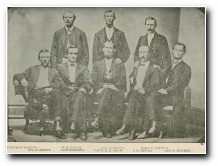
The group was lead by a man known by the alias of E. Coleman. When he wasn’t actively involved in missions of covert operation for the Confederacy, Captain Coleman lived within enemy territory disguised as an herbal doctor. He was the mastermind behind the group and held to a list of five characteristics he required of his scouts.
• Young, preferably in their early twenties
• Unmarried, so that they would not hesitate to charge into dangerous situations
• Highly familiar with the terrain of Middle Tennessee
• Expert horseback riders
• Possess intelligence, bravery, and unmatched loyalty
These strict requirements formed a band that was hated deeply by the Union troops in Tennessee.
The Boy Hero of the Confederacy
Among the group of elite Coleman Scouts was twenty-one year old Sam Davis. Davis had fought under the command of Robert E. Lee and Stonewall Jackson before being selected for the ranks of the Coleman scouts by his brother, John Davis.
It is quite certain he never expected his life to take the turn it did on the night of November 20, 1863. He had been near Nashville for a time, gathering information on the movement of Union troops. At some point while there he managed to ascertain papers revealing the defenses of the city. He then received orders from E. Coleman to carry the papers to Confederate lines.
Before he left, he stopped at the Hugh Patterson house. The Pattersons were strong allies of the Coleman Scouts. Mary Kate Patterson was Sam’s soon to be sister-in-law, and one of the Patterson sons was a member of the Scouts. The Scouts frequently visited their house for a home cooked meal or to warm up from the cold. More importantly, they came to receive secret information that Mary Kate had gathered for them. Frequently Mary Kate and her cousin, Miss Robbie Woodruff, would take trips into town to buy supplies that the Scouts needed.
This particular day, Sam needed a pair of boots and spurs to make the long ride to Confederate headquarters. Neither Sam or the Patterson family had any way of knowing that it would be the last time they would see each other.
The following day he was captured by Union soldiers just outside of Pulaski, Tennessee. Several of his fellow scouts also fell into Union hands that night. They were taken to the county jail as suspected Confederate sympathizers. But for Sam, things were much worse. He had been found with the incriminating papers hidden beneath his saddle, in his coat, and in his boots.
Not only did he carry this contraband, but also a pass signed by E. Coleman. This pegged him as a Coleman Scout and earned him special attention from General Grenville Dodge, commander of Union forces around Pulaski.
General Dodge was desperate to capture Coleman and put an end to his Scouts’ missions. Capturing one of Coleman’s men was just the opportunity he had been waiting for. He had Davis brought before him for questioning. This proved futile, as the boy barely said a word.
“I tried to impress upon him the danger he was in and that I knew he was only a messenger, and held out to him the hope of lenient treatment if he would answer truthfully, as far as he could, my questions.“
General Grenville Dodge
Who was E. Coleman? Where could he be found? Who had given Davis the papers? What of the other Scouts?
No response was given by the Confederate. Dodge threatened to hang him as a spy if he didn’t answer, but still Sam seemed unmoved.

He was taken back to his cell in the county jail, but Dodge was not finished trying to get information. The Yankee general went so far as to place an informant in the adjacent cell with hope that he would confide in a fellow rebel.
When this method also failed, Dodge called a hasty Court Martial that tried Davis as a spy. Davis plead guilty to carrying papers that were considered contraband, but maintained that he was innocent of espionage.
The evidence presented in the court overwhelmingly showed that he was, by all definitions, a soldier and not a spy. As such, he should’ve been given the protections of a prisoner of war which would not have allowed for him to hang.
The pass he carried openly informed the Union soldiers who captured him that he was a Confederate soldier, and all of the arresting soldiers testified that he was in fact wearing a Confederate uniform when he was caught.
Despite this evidence, the Court Martial found him guilty on all charges and sentenced him to death by hanging.
Pvt. C. B. Van Pelt was given the duty of reading Davis his sentencing. He wrote of this experience,
“I read to him a copy of his death-sentence yet a reprieve was extended, which I read to him also, if he would inform us where “Coleman” was. He stood before me, an uncrowned hero, his eyes flashing, and said: “I will die a thousand deaths rather than betray my cause.” We were both moved to tears and remained silent for a time. He then talked of his family.”
When word of Davis’ upcoming execution spread through the area, outrage ensued. Union soldiers and Confederate civilians alike disapproved of Davis’ hanging, and even formed a delegation to plead for his life. However, no leniency would be given. Unless Sam Davis betrayed his country and fellow scouts, he would die.
The evening before his execution, Davis penned a letter to his family. He ended the letter, only to come back later and add on to it as his imminent death grew closer.
Pulaski, Giles County, Tenn., Nov. 26, 1863
Dear Mother: Oh, how painful it is to write you! I have got to die to-morrow morning–to be hanged by the Federals. Mother, do not grieve for me. I must bid you good-by forevermore. Mother, I do not fear to die. Give my love to all.
Your son, Samuel Davis
Mother, tell the children all to be good. I wish I could see you all once more, but I never will any more.
Mother and Father, do not forget me. Think of me when I am dead, but do not grieve for me. It will not do any good. Father, you can send after my remains if you want to do so. They will be at Pulaski, Tenn. I will leave some things, too, with the hotel keeper for you. Pulaski is in Giles county, Tenn., south of Columbia.
S.D.
James Young, a chaplain from the 81st Ohio, spent that evening with Davis. They shared a devotional together and Davis requested that they sing “On Jordan’s Stormy Banks”. Young reminisced after the war that Davis sang with animation not expected from a man condemned to die.
Early the next morning Davis was led to a wagon outside the jail. His hands were tied behind him and shackles were placed around his ankles. With painstaking steps, he boarded the wagon. He glanced back to the jail for a final salute to his fellow scouts languishing within its walls. He found them watching from the windows of their cells and bowed to them slowly, intentionally. His coffin was the only seat available in the bed of the wagon as it lurched along the road, surrounded by a sea of Union soldiers.
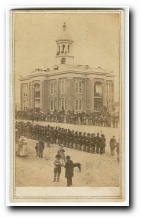
At five minutes past ten o’clock, Sam Davis came face to face with the gallows that would usher him into eternity. Provost Marshal Armstrong recalled that Davis asked how much longer he had to live.
“Fifteen minutes,” Armstrong replied.
Davis asked for an update on how the battles were going. When given the news that the Union had won a recent victory at Missionary Ridge, Davis was deeply saddened. He said wistfully, “The boys will have to fight the rest of the battles without me.”
One final chance was given to spare his life. If he would betray the identity and location of his Captain and fellow scouts he would be given a horse, sidearms, and an escort to Confederate lines.
Davis remained unshaken in his resolve to “die a thousand times” before he would “betray a friend and his cause”.
With the rope around his neck, Davis turned to Armstrong and said “I am ready.”
Many of the soldiers who witnessed his death wondered why he so vehemently refused to give up the name of his commander and save himself. The answer was one that only Davis and his fellow Coleman Scouts knew. Not only did the Union troops not realize that they were holding multiple other Coleman Scouts, but in an adjacent cell of the Giles County Jail resided H. B. Shaw, alias E. Coleman. He had been captured only days after Davis. Knowing that Shaw and the other Scouts would be put to death if his captors discovered who they were, Davis chose to die in their place. In the final days of his life he reflected the truth of John 15:13.
“Greater love hath no man than this, that a man lay down his life for his friends.”
John 15:13
For his heroic actions, Sam Davis became the first man to receive the Confederate Medal of Honor.
Remembering Sam Davis
Over a century has passed since Sam Davis gave his life for his friends and the cause he so deeply loved. His tale has been told and retold, even becoming the focus of multiple ballads and poems. Soldiers spoke of his courage and bravery around campfires in the darkest hours of the war and young boys dreamed of being heroes like Sam Davis.
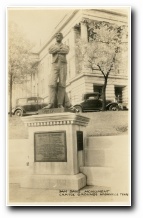
In 1909 a monument was erected on the grounds of the Tennessee State Capitol in honor of his life, courage, and sacrifice. It is interesting to note that the bronze figure of this young hero was funded by contributions from every state in the American Union. His story had been carried home by Union soldiers who witnessed the heroic way he died, and respect for the “Boy Hero of the Confederacy” only grew.
For the citizens of Pulaski that wasn’t enough to honor a man they held in such high esteem. In 1950 they built a memorial at the sight of his execution. It remains to this day a testament to the profound patriotism he displayed on that November day of 1863.
It is no surprise many have given him the title “Nathan Hale of the Confederacy”. The two men bore many of the same characteristics as one another. Both were twenty-one year old patriot martyrs who would’ve given many lives for their nation if presented the opportunity. Separated by eighty-seven years, courage and sacrifice ties their stories together.
History is intended to be studied and learned from. From the examples of men like Nathan Hale and Sam Davis we can be inspired to live courageously and stand strongly for what we believe.
What would you have done in the same situation?
 Seeking The Timeless Anchor
You’re making me cry. Again! Thank you for sharing this story!!!!!
LikeLiked by 1 person
Aww, sorry about that! 😅 Glad you enjoyed it though.
LikeLiked by 1 person